
Thinking about some 'moral ambition' and climate journalism
Taking a look at the popular book from the Reith Lecturer and historian which sets out a challenge


“Every hour, enough sunlight reaches the planet to power the earth for a whole year.” Rutger Bregman, Moral Ambition
Does the statement above surprise you? It certainly stopped me in my tracks. I’ve been reading Bregman’s chunky and inspiring book after finding it in the Christmas stockings and came across this statement on page 140.
The book, which has the full title Moral Ambition Stop Wasting Your Talent and Start Making a Difference, is one of those tomes which sparks a zillion thoughts and prompts multiple readings.
You don’t have to take my word for it, the sleeve cover has praise and recommendations from big names as varied as inspirational optimist Hannah Ritchie, eternal centrist Rory Stewart and dogged environmentalist George Monbiot alike.
Written by the famous historian Bregman (who was also last year’s Reith Lecturer), Moral Ambition isn’t a book just about solar energy or even climate issues. There’s a lot about the slave trade and its abolition, civil rights movements, the second world war and more. But his chapters about the advent of electricity and solar energy particularly caught my eye because I was simultaneously also seeing lots of discussion online about this:
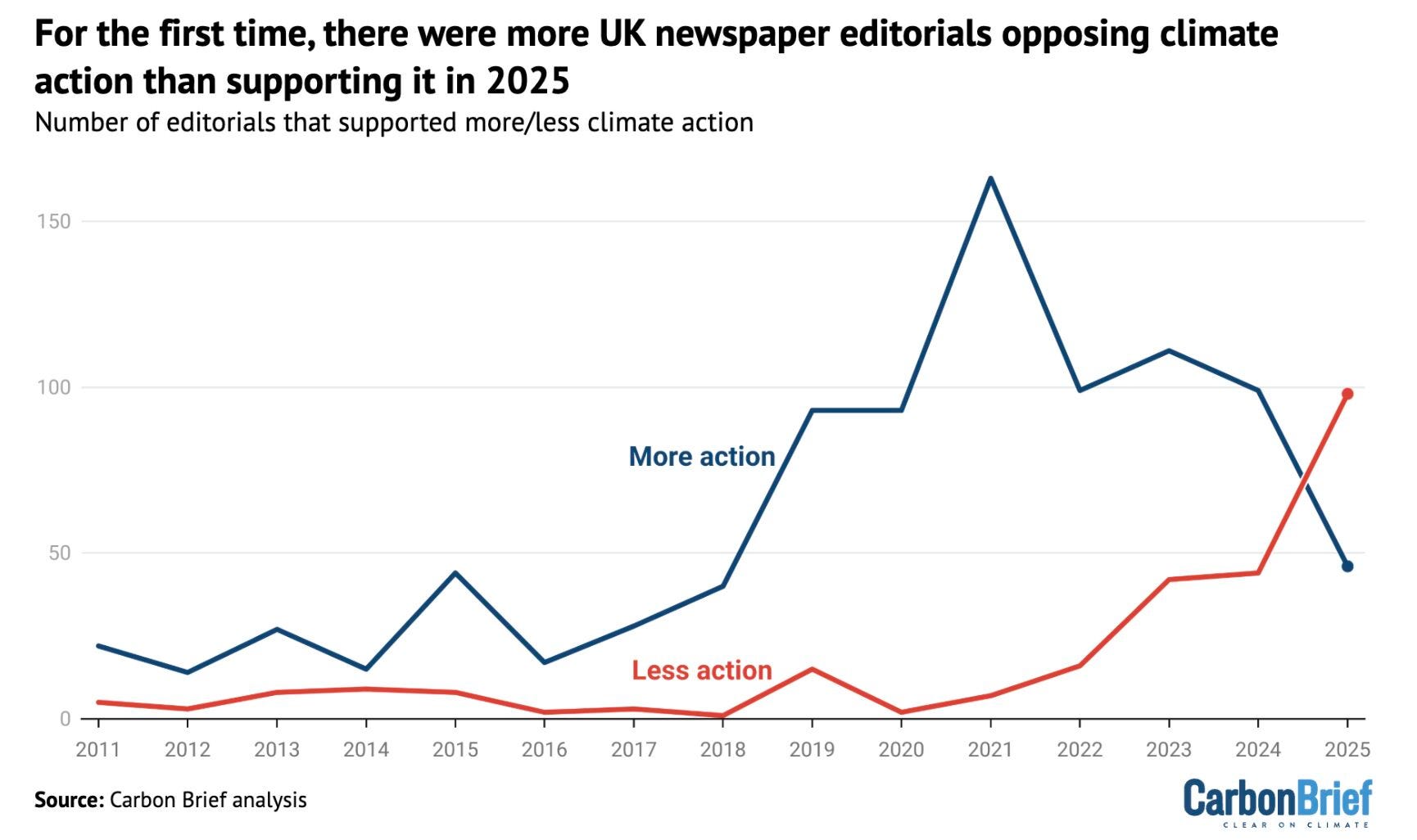
“Nearly 100 UK newspaper editorials opposed climate action in 2025, a record figure that reveals the scale of the backlash against net-zero in the right-leaning press.
Carbon Brief has analysed editorials – articles considered the newspaper’s formal “voice” – since 2011 and this is the first year opposition to climate action has exceeded support.” (The full article is here)
How can this have happened?
The first thing to note is that “newspaper editorials” are not all the contents of any given newspaper. An editorial is a leader column i.e. the voice of the editor. As a journalist I’d like to think that the publication I wrote for had an editor I could agree with but, lets be realistic, that can not always be the case. There’s plenty of journalists hard at work on publications who don’t necessarily agree on all stances and every aspect of their editor’s views. Even accepting that, it is worrying to see such a shift at a time when people (readers) desperately need cheaper home and business energy and renewables like solar will easily produce that.
Where does that get us?
If newspaper editors think people don’t want to hear about action on climate change, then they’re less likely to commission writers to present those arguments meaning less readers (people) are exposed to the facts. Chicken - egg - chicken.
The mismatch between what is achievable and the attitudes of the leader writers tracked above could be depressing. It could seem like those of us writing about environmental challenges are doing nothing more than shouting into the void, only being heard by those already signed up to a particular hymn sheet.
That is a justifiable fear and I admit it was my first reaction to the graphic above. But Bregman’s book gives some hopeful advice on tackling such a mismatches between the idea of what is needed and the means to reach it. He gives many examples from history to make the point that the big important campaign battles of the past were not won by simply bludgeoning the core argument.
“Many activists think you have to hold tight to your highest ideals. he writes, “But sometimes you have to aim lower if you want to hit your target.”
So, like the activists who campaigned on better conditions for the sailors on slave ships in order to move public interest against the vested interests of the slave trade, environmental journalists will need to think creatively to move the needle on this debate.
Simply broadcasting the facts and science isn’t doing the job, we can all see that. But what will? There’s the first question to answer and I’d love to hear your thoughts. As Bregman urges:
“The climate movement is one giant jobs fair, with work for millions of morally ambitious people. It’s all hands on deck, because we have a mission to accomplish in the coming decades that knows no precedent.”
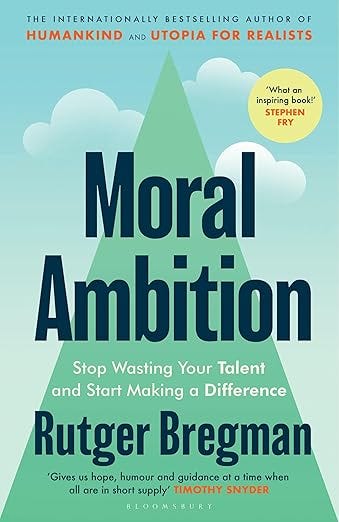
Bregman’s book ends with a Call to Action for people to join his mission and help empower “idealistic entrepreneurs”. There’s free tools and resources to sign up at moralambition.org which I’m certainly going to follow up on.
Listen to the Reith Lectures 2025.
If you want a copy of the book Moral Ambition, you can purchase it from our friends at The Wonky Tree online bookshop here.
I hope you’ve enjoyed this edition of The Planet on Sunday. If so, please help me spread the word by sharing via the button below or giving this post a ‘like’. While I can’t guarantee that I’ll be here every single Sunday, I will try. Till next time…..have a great week!
You’re tracing the arc of my sustainability journey here Sarah, from establishing the only mainstream economic strategy with an ambition to go beyond net zero - right here in North Yorkshire - to helping people do the inner work that really creates transformational change. I’ve even featured one of Bregman’s other books, Humankind, in my book subscription. The answer is not to send in the scientists like the National Emergency Briefing, but to send in the storytellers - like Mr Bates versus the Post Office. We need to find a way to help people connect, on a deeper, felt level with something that is too big and too scary to approach head on, like looking at Medusa in a polished shield to avoid being turned to stone. News has always known that emotion matters, but unfortunately the dominant emotion most editors seem aware of right now is fear, perhaps because so much of the previous peak simply stoked that fear without leaving readers anywhere to go.