
Inside the 3D printed home for people in need
We’re taking a virtual flying carpet ride around the globe picking up positivity as we go

Good morning! I’m Sarah Hartley and this is my curated Sunday read from across the globe, The Planet on Sunday. As you’ve received this newsletter then either you subscribed, or someone forwarded it to you. If the latter, then you can return the favour using the handy little button below.
Previously this newsletter was housed within The Northern Eco - the newsletter which looks at local environmental issues from the north of England. Now, it’s ‘come of age’ and gets to stand on its own two feet in this dedicated newsletter! I hope you enjoy the selection this month and would love to hear what you think in the comments.
Don’t build a house - just print your new home!
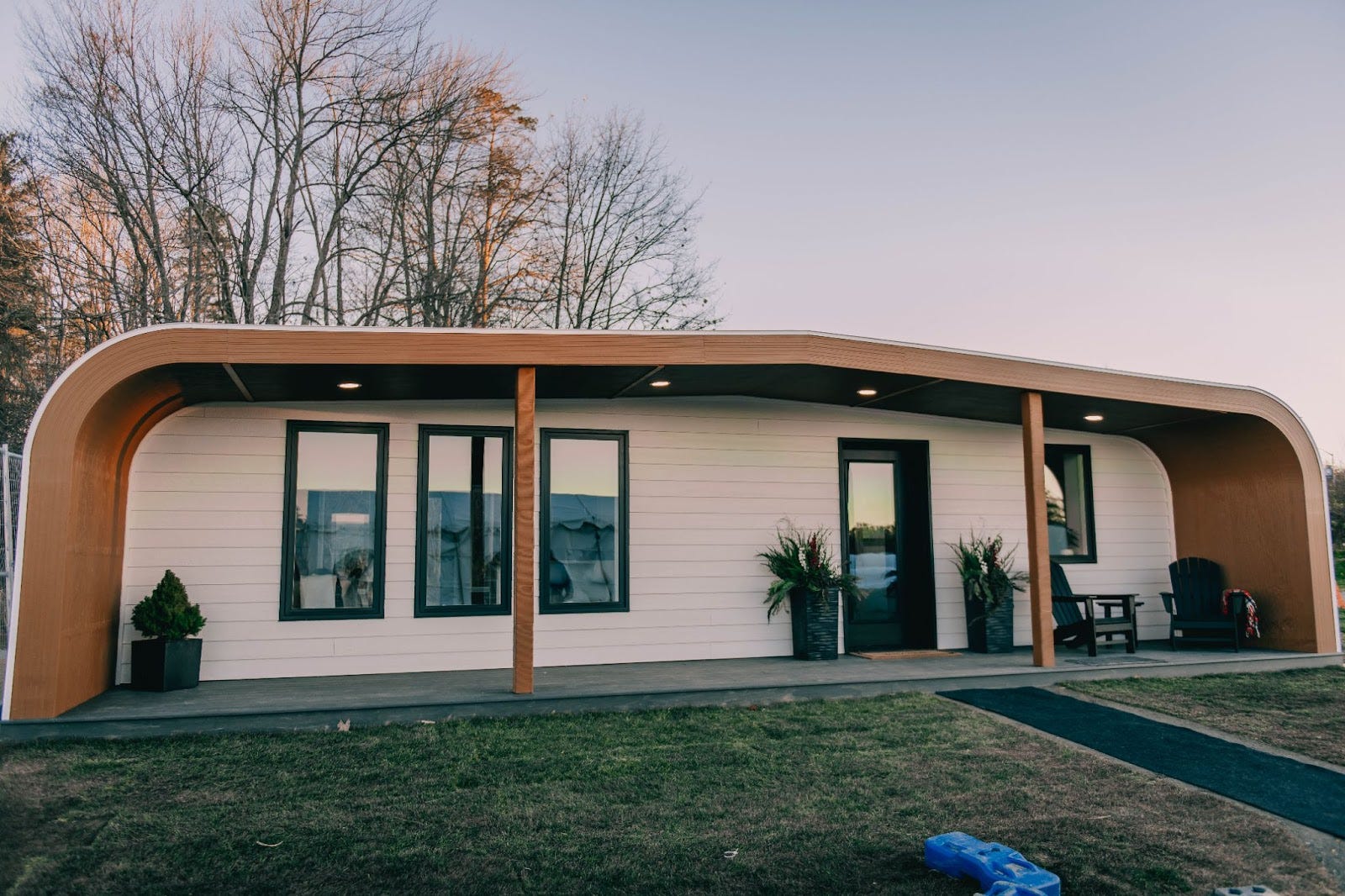
3D printing has grown in popularity in the construction industry thanks to its efficiency when it comes to time, energy and cost but that has also prompted use of carbon-intensive concrete as the go-to building material.
But in the USA, a project in Maine is trying something different: a neighborhood of 600-square-foot, 3D-printed, bio-based houses crafted from materials like wood fibers and bioresins. Their aim is to produce a complex of 100-percent recyclable buildings that will provide homes to those experiencing houselessness.

And looking at these pictures, the style, finish and attention to detail is something far away from boxy concrete blocks.

Miranda Lipton at Reasons to be Cheerful reports on the initiative here:
“In late 2022, an initiative between the University of Maine and local nonprofit Penquis unveiled its prototype — BioHome3D, the first 100-percent recyclable house. Now, the pioneering project is working toward completing its first livable housing complex. It will be fully bio-based, meaning all materials will be derived from living organisms such as plants and other renewable agricultural, marine and forestry materials.”
🇮🇳 Snow leopard population in India surveyed for the first time
India’s first survey of snow leopards has found an estimated 718 cats living in the country.
Snow leopards live in a harsh environment, high in the Himalayas which has long made it difficult for scientists to study these animals, let alone complete a thorough survey. The first-ever Snow Leopard Population Assessment provides more insight into the snow leopard population and their habitat.
Paige Bennett of Eco Watch has the full report here.
❄️ Startup’s plan to restore Arctic sea-ice
Every winter when the temperatures drop, the IJsmeester (ice master) in villages around the Netherlands carefully starts to flood a field with water to form enough thin layers of ice to create a perfect outdoor skating rink.
Now a Dutch startup wants to use the same technique to help solve a major ecological problem: melting Arctic ice and its devastating effect on the climate.
The Guardian’s Senay Boztas has the full report here:
“In cold weather, the IJsmeesters start a frantic race to be the first village that can organise an ice-skating marathon,” says Fonger Ypma, chief executive of Arctic Reflections. “They flood a meadow with a thin layer that becomes ice, and every night they apply more thin layers on top of it. And then, once it’s thick enough, they start skating. It’s our cultural heritage.”
Take Action: If you’re concerned about melting Arctic ice and its impact on the wildlife, you’ll want to know that International Polar Bear Day took place this week - February 27. The day was selected to coincide with the time period when polar bear mums and cubs are snug in their dens. The charity Polar Bears International celebrates the animals by focusing on the need to protect denning families across the Arctic. You can donate to the work here.
🇹🇭 Removing 2 million pounds of rubbish from waterways
The TerraCycle Global Foundation reached an impressive milestone last month, announcing that they’ve removed more than 2 million pounds of waste from rivers, canals, and waterways.
Since its founding, the nonprofit organisation has targeted ocean pollution right at its source - waterways. When polluted, they send waste directly to oceans, harming sea life and the environment. Over 1000 tons have been diverted and recycled.
Operating in canals throughout Bangkok, Thailand, TerraCycle’s “world-class river waste prevention systems” are implemented with the local community and governments to address the complex challenge of collecting waste before it enters and pollutes global aquatic systems.
The Foundation is currently operating wildlife-safe river traps in Thai canals to recover waste directly from the water. The waste is then sorted, and plastics are separated and recycled.
The full report is at the Good News Network here.
🌍 Herd of puppets to trek 20,000km to highlight urgency of climate crisis
The production team behind the Little Amal puppet, which raised awareness about the plight of the refugee crisis in Europe, hope their next project – a herd of animal puppets going on a 20,000km trek – will start a new global conversation about the climate crisis.
Amir Nizar Zuabi, the Palestinian artist who helped launch the Amal project, told Lanre Bakare at The Guardian that The Herd – which will tour through several African and European cities and feature dozens of puppets – will be a “soft, beautiful evocation to think differently” about the climate crisis.
“Climate change is the biggest story we’re facing now,” said Zuabi. “It’s often presented in terms of emissions and the Kyoto agreement – people struggle to fathom that, but what Amal did beautifully and what we hope The Herd becomes is a visceral engagement with the issue.”
The Herd will start its journey in west Africa in spring 2025 – the precise point is still to be confirmed. The planned route includes Senegal, Morocco, Gibraltar, Spain, France, the UK, the Netherlands, Denmark, Sweden and finally Norway.
Enjoy the full interview here.
The three most clicked links from last month:
Key climate language poorly understood by majority in UK, poll finds
Thank you for reading The Planet on Sunday — your support allows me to keep doing this work.
If you enjoy The Planet on Sunday, it would mean the world to me if you invited friends to subscribe and read with us.
How to participate
1. Share The Planet on Sunday. When you use the “Share” button on any post, you'll get credit for any new subscribers. Simply send the link in a text, email, or share it on social media with friends.
2. Earn benefits. When more friends use your referral link to subscribe (free or paid), you’ll receive special benefits.
Get a 1 month comp for 3 referrals
Get a 3 month comp for 5 referrals
Get a 6 month comp for 25 referrals
To learn more, check out Substack’s FAQ.
Thank you for helping get the word out about The Planet on Sunday. See you next month for more.
PS. If you want to read previous issues, they can be found here.